It smacks of
orientalism to use the term “dynasty” in reference to current East Asian
politics. The days of kingdoms and emperors are gone, the nation-state having become the global standard. Too often I read references to Xi
Jinping as an "emperor,” and they just come off as lazy journalism. No one in
China believes that Xi has a divine mandate to be their leader any more than
Americans truly think that God whispers policy suggestions to Ted Cruz. All the
same, when you look at the current batch of leaders in East Asia, its hard not
to see the family pedigrees that enabled their rise to power.
For this blog
post, I would like to focus on three heads of state: Park Gyun Hee of South
Korea, Kim Jong Un of North Korea, and Shinzo Abe of Japan. You were probably
aware that North Korea has always been led by the descendants of its founder, Kim
Il-Sung. You might not have known that in South Korea, Park Gyun Hee’s father, Park
Chung-hee, was a controversial dictator who was in power for much of the 60s
and 70s, or that Shinzo Abe’s grandfather, Nobusuke Kishi, was the Prime
Minister of Japan from 1957 to 1960. These three men were each significant
leaders and their policies dictate much of the current dynamics in East Asia
today. In positions of power, each demonstrated a unique ability to reshape society,
economics, and their militaries.
But before these
men rose to power in their own country, they all participated in or against
Japanese colonialism in Manchuria. Their experiences were foundational for the ideology of Kim Il-Sung, Park
Gyun Hee, and Nobusuke Kishi, and their descendants have, in many ways, continued the projects of
their fathers. If we are to understand the ambitions of South Korea, North
Korea, and Japan today, let us look to the history of Japanese colonialism, and
how it has influenced these three leaders. To go forward, we must go back. To
see the future of East Asia, we must step into the frigid deserts of Manchuria
in the 1930s.
 |
| Image Courtesy of Wikimedia |
Like all other colonizers
in history, the Japanese aimed to legitimize their takeover of the region. Conveniently
for them, the Qing dynasty originated from Manchuria, and so they installed Puyi,
the last emperor of the Qing dynasty in the top slot of a puppet state they
called “Manchukuo.” Puyi had spent much of his life being pushed around and
manipulated since his family had fallen from power, so he settled nicely into
the role of a figurehead. All decisions in Manchukuo were made by military
leaders and bureaucrats sent to manage the colony.
The brutality of
the Japanese colonization in Manchukuo cannot be understated. Drug trafficking,
slave labor and human experimentation were all facilitated under Japanese
policy in Manchuria. One of the most infamous examples is Unit 731, a division
of the military that performed horrific torture on civilians and prisoners
under the banner of “research.” I won’t go into details here but there is
fairly lengthy Wikipedia article that covers the atrocities they inflicted on an
estimated 250,000 men, women, and children. After Japan’s surrender, Douglas
MacArthur gave immunity to the researchers in return for their findings. While
Unit 731 is one of the more extreme examples, even the basic economic policy of
Manchukuo functioned on human rights violations.
Both forced labor
and the opium trade based in Manchukuo demonstrate the racism of Japanese
colonization. In a move borrowed from the British Empire’s playbook, the
Japanese cultivated opium to generate profit and destabilize foreign powers. Just
as the British trafficked opium from India to weaken the Chinese state, so too
did the Japanese grow opium in Manchukuo and distribute it across Asia. In
1937, the League of Nations reported that 90% of opium was produced by Japan. By
locating both the production and distribution in Manchukuo, the Japanese government could claim ignorance while inflicting a public health crisis across Asia. Once Japan’s aggression in China
became part of the larger WWII conflict, factory production in Manchuria was
accelerated with slave labor. Manchuria is rich in natural resources and the
Japanese hoped that it could serve as an industrial base for their military expansions.
The Japanese here pressed an estimated 10 million Chinese laborers into
high-risk jobs, such as the Benxihu Colliery, the site of the deadliest mining
disaster in history.
While there was no
single architect of these atrocities there was a bureaucrat who ensured that
each was accomplished efficiently and through the combination of private
capital and Japanese military support. Nobosuke Kishi, the grandfather of
current Japanese Prime Minister Shinzo Abe, laundered money, oversaw heroin trafficking,
and brought private capital into Manchukuo industry. He was also, by most
accounts, a racist bigot and serial hedonist, gleefully patronizing the sex
industry fueled by kidnapped Korean and Chinese women. Kishi created his models
for economic development before he came to Manchukuo, influenced by trips to
Germany and the scientific management theory of Fredrick Winslow Taylor. It was
in Manchukuo, however, that Kishi was able to shape a society towards his
vision. Later in life, he would describe Manchukuo as “a scientific, conscientious, bold experiment … a
truly unique modern state formation.” Under Kishi’s management, private enterprise
directed the Japanese military to commit atrocities throughout Manchuria.
 |
| Image Courtesy of Japan Philippines Society |
Kishi was far from
the only imperialist Japanese (businessmen, intellectuals, and the military establishment all pushed for expansion) but he was unique in that he facilitated a
truly military-industrial complex for the purpose of that imperialist vision. Prior
to Kishi’s appointment as Manchukuo’s Deputy Minister of Industrial Development
in 1935, the military refused to allow private enterprise in Manchuria, instead
managing the economy themselves. For the first half of the twentieth century, Japan’s
economy was dominated by massive corporation known as zaibatsus. Typically controlled by a single family, zaibatsus possessed holdings in multiple
industries and had their own in-house banking institution to fund operations. As
opposed to large corporations in the United States, zaibatsus have generally held a more cooperative role with the
state instead of dictating select policies to generate greater profits (looking
at you, Koch Brothers). The Japanese government relied on the zaibatsus to establish trade
connections, develop industries that served the national industry, and invest
in Japanese colonies.
But how did Kishi
incentivize the zaibatsu? Simple, he guaranteed
them the cheapest labor possible. Under Kishi, wages in Manchuria were dramatically
lowered and as the war accelerated, he eventually ignored wages and instituted slave
labor. 10 million Chinese were forced into high-risk labor, such
as at the Benxihu Colliery, the site of an industrial accident that killed an
estimated 1,549 miners. Kishi believed in the
superior of the Japanese, (or Yamato)
race, a belief that encouraged him to enslave the necessary labor. One
historian quotes Kishi saying that Chinese should be “mechanical instruments of
the Imperial Army, non-human automatons, absolutely obedient” to the Japanese
colonizers. This racist urge for dominance was also present in Kishi’s sexual
appetite. Kishi was known to frequent prostitutes, demand sex from waitresses at
restaurants, and given his position in the Japanese leadership, was undoubtedly
aware of the “comfort women,” Korean women who the Japanese army kidnapped and
coerced into sexual slavery.
Nobosuke Kishi
entered Manchuria with an established viewpoint on markets and administration. He
had studied the planned economies of the Soviet Union and Germany, and had embraced
the Yamato superiority argued by a number of authors. For him, Manchuria was a
place to apply these different theories. He did not learn lessons here so much
as conduct experiments, letting private business dictate military procedure. In
Kishi’s mind, only profit could enable expansion. These profits did not even
need to come from honest sources, as his involvement in the drug trade illustrates.
Kishi’s consuming drive for economic development blinded his morality, allowing
him to endorse the drug-trade, sex trafficking, and the enslavement of the
Chinese to feed a mercantilist machine.
There was another
man in Manchuria at this time, a lieutenant who was observing the experiment of
Manchukuo just as closely as Kishi. This man too respected the relationship
between private capital and militarism, but felt that Manchukuo had the
relationship backwards. Park Chung-hee, the father of current South Korean
president Park Geun-hye, studied the situation in Manchuria closely, biding his
time for the moment to implement a similar experiment in his own home.
 |
| Image Courtesy of Britannica |
In 1939, Park
Chung-hee was 23-year-old elementary school teacher in the Korean countryside, brimming
with ambition and hungry for adventure. Previously, he had applied to the
Japanese military academy but had been denied and was now too old to be
accepted. Sitting down at his desk one afternoon, Park Chung-hee decided that
if he demonstrated enough passion to the Japanese military, he would surely be
accepted into the military. And so he pulled out a paper and quill, found
something sharp and wrote a letter written in his own blood, requesting a
chance to fight with the Japanese in Manchukuo. The letter, titled “Loyalty Up
to Sacrificing My Own Life,” would set Park Chung-hee’s life on an upward path in
the military hierarchy, continually ascending until he became the dictator of
South Korea from 1961-1979.
From his “blood
letter” onwards, Park Chung-hee would always enjoy a theatrical flavor with his
reverence to the Japanese military. Some reports say that Park Chung-hee would
wander around the gardens of the presidential palace wearing his old Japanese
uniform. While serving with the Japanese, he took the name “Masao Takagi.”
Armchair psychologists might claim that Park Chung-hee was attempting to erase his identity as a Korean, but I think this speaks more to the
admiration Park Chung-hee had for the Japanese military and economic
policies than an attempt to erase his Korean identity. Park Chung-hee’s personal
philosophy was founded on a militarist values. After a military coup in 1961 gave
Park Chung-hee dictatorial powers over South Korea, he could begin
leading a country with this philosophy.
Park Chung-hee is
fondly remembered as the architect of “The Miracle on the Han River,” an
economic development project that made Korea one of the most successful
countries in the world. Like Manchukuo, the “Miracle on the Han River” married
large business interests and the military into a state-run military-industrial
complex. The most visible legacy of Park Chung-hee’s development model is the
dominance of the chaebols, massive
conglomerates run by families. These corporations are modeled on the zaibatsus Kishi wooed to invest in
Manchuria. Samsung, Hyundai, LG and a small handful of other corporations are
the current backbone of the Korean economy. Like the zaibatsus, these businesses have diverse holdings that cater to
needs across Korean societies. While you may know Samsung for their exploding
smartphones, they also sell fire insurance to cover any incidents related to
those phones, and own a medical center to treat any burns you could
have received from their phones. The dominance of these chaebols across such diverse industries is a direct result of economic
stimulation undertaken by the Park regime.
But what makes
this policy militaristic? Park Chung-hee favored businesses with clear
strategic value, such as energy and industrial production, but the true
militarism of Park Chung-hee’s regime came from his use of the military to
legitimize the government and their policies. Nobosuke Kishi used private
capital to direct the military, while Park Chung-hee used the military to direct
private capital. Park Chung-hee brought an officer’s discipline to his
governing style, frequently inspecting construction projects and demanding
exact deadlines and progress reports. A diplomatic cable from the United States
described Park’s leadership as “that of a general who desires that his orders
be carried out without being subjected to the process of political debate.” In
his personal life, Park Chung-hee lived modestly and apparently put a brick in
his toilet to conserve water. In contrast to the infamously corrupt Nobosuke
Kishi, Park Chung-hee refused the bribes or embezzlement that typically
cushioned any military salary while stationed in Manchuria.
 |
| Park Chung-hee in Uniform. Image courtesy of Wikimedia. |
These anecdotes of
thrift and discipline were not the only militarist aspects of Park Chung-hee’s
regime. The military and intelligence services committed brutal crackdowns of
dissenters and critics, one notable case being the kidnapping of a major
opposition leader who had been hiding in Japan. In military prisons, Park’s
cronies would chain their political enemies over fire pits or stage mysterious
accidents to kill opposition politicians. Even in these vicious tactics of
political suppression, there remained a kind of discipline to their actions. Under
Park, the typical sadism of dictatorial regimes was focused and directed. This
in no way mitigates the human rights violations and objectively evil actions
that he approved of, but I still feel this distinction is crucial. This
surgical methodology was another lesson that Park took from his time in
Manchuria.
In Manchuria, Park
witnessed the depraved violence under the Japanese as hedonistic businessmen
dictated military policy. Even the policy of sexual enslavement by the Japanese
can be traced to the consumptive mindset of the private firms that Nobosuke
Kishi brought into the region. The forced labor polices in Manchuria were a result of Kasha's racism, and this same racism encouraged the sexual entitlement of the Japanese towards the Chinese and Koreans. Park learned from these unregulated
acts of exploitation and flipped Kishi’s machine upside down. In South Korea,
the military would control business, not the other way around.
For both of these
men, the Manchukuo experiment would be centered on themes of militarism and capitalism,
and which force would lead the other. Northeastern China is a rich in natural
resources, which generates an understandable focus on industrial production. For
both of these men, the state was to function as a rational, capitalist agent. Legitimacy was derived from the material production of the economy, and it was the duty
of the state to grow wealth and ensure that wealth was protected and invested. But the
rationality of these two men was countered by an equally effective, irrational style of production. On the
opposite side of the colonization, in the communist resistance, a young Korean
man began to appreciate the value of symbolic victories over material ones. The
state did not need to produce material value, but could instead produce imagination.
This young man was Kim Il-sung, and though his experiences in Manchukuo are a vital
piece of his story, but they were never as significant as the subsequent
fictions he crafted around them.
Kim Il-sung
shrouded much of his personal history in shadows, but here are the established
facts of his life. He was born in 1912, the same year that 52,000 Koreans were
arrested by the Japanese for politic activities. He was the son of a patriotic
peasant family, and his parents were committed opponents of the Japanese
colonization of Korea. Like many Koreans, they came to Manchuria for economic opportunities but also by the opportunities to join the anti-colonial movement there. In
lawless Manchuria, a diverse coalition of communists and bandits from both
China and Korea were mounting a bitter resistance movement to the Japanese. Kim
Il-sung would receive some formal education in China but his true learning would
be on the battlefield.
 |
| Image Courtesy of Wikimedia |
When he became a
guerilla fighter in 1926, Kim Il-sung joined a cosmopolitan army. The communists
were the leading resistance fighters in Manchuria, a fact that can be credited
to their support from Comintern, the Soviet organization devoted to the agitating
communist revolt across the globe. The Chinese Communist Party began as a small
group of academics and students, but arms and monetary support from Comintern shaped
them into a dangerous political force. Though Manchurian annexation pitted
Chinese against Japanese, this conflict must be recognized as multi-national,
not bilateral. The Soviets backed the Chinese communists, who fought the
Japanese, while both sides bolstered their ranks with Koreans. In this pyramid
of conflict, a Korean like Kim Il-sung comes off as an insignificant
character pulled around by larger powers.
The brilliance of Kim
Il-sung was that he portrayed his years in Manchuria as a patriotic
Korean struggle. North Korean propaganda reversed the pyramid, giving himself a
commanding role in the fight against Japan. Kim owed most of his rise to power
to intervention from China or the Soviet Union, but he succeeded in turning his
cosmopolitan identity into a purely Korean one. As I will try to demonstrate,
while fighting the Japanese, Kim fought on behalf of the Chinese, not the Koreans.
Kim Il-sung was an
undeniably effective guerilla fighter. After joining the Chinese Communist
Party (CCP) in 1931, his unit of Korean and Chinese fighters proved to be a
thorn in the side of the Japanese. Within years the Japanese had a price on his
head and he switched his birth name, Kim Song-ju, to Kim Il-sung. Ironically,
it was the Japanese efforts to combat Koreans that brought Park Chung-hee to
Manchuria. It is almost impossible that Park Chung-hee and Kim Il-sung ever
faced each other directly, but they were all pulled into an orbit around
Communist resistance to Nobosuke Kishi’s tyranny in Manchukuo. You might think
there was a literary quality to this struggle, where hyper-capitalist
militaries and cosmopolitan communists duked it out the Wild West of East Asia.
Well, you wouldn’t be the only one who saw the literary potential of this drama.
With the Century, the autobiography of
Kim Il-Sung, is one of the most beloved books in North Korea. This seems a
silly claim, since there is probably a very short list to choose from of
favorite North Korean books, and the Dear Leader probably wrote most, but With the Century recognized as having
genuine literary merits. A professor of mine here said that, despite its propagandistic
qualities, the book is beautifully written. In this autobiography, we see the
meteoric rise of a poor farm boy who discovers communism at age thirteen and
devotes his life to creating a utopian state. With the Century is a crucial piece of the massive historical
project that North Korea has engaged in. Not only are these efforts to control
the history of the Korean peninsula, but also the history of a single man. Kim
Il-sung grew up in China, was a member of a Chinese anticolonial movement, and
later fled to the Soviet Union, who facilitated his ultimate rise to power during
their occupation of the northern half of Korea. With the Century and the propaganda effort it is a part of flips
the relationship between a man and his times. Kim Il-sing is not considered in
the context of the wars he fought in, but those wars and foreign affairs are re-contextualized
into his celestial path towards the throne of the Democratic People’s Republic
of Korea.
 |
| Kim Il-sung with his family in the Soviet Union. Image Courtesy of Alpha History |
I believe that Kim
Il-sung learned this lesson of recreating history almost accidentally, when one
of his strikes against the Manchukuo state was absorbed into a context of
Korean independence. As the campaign against communist guerillas intensified,
the Japanese ironically created one of the most important moments in the imagined
history of Kim Il-sung. In 1937, the Japanese had been brutally suppressing Kim
Il-Sung and his communist allies and the young revolutionary was growing
desperate for a victory. In typical warfare, such a victory would have seemed
unlikely, given that Kim Il-sung was running an amateur operation when compared
to the professional Japanese military. However, in guerilla warfare, symbolic
victories are just as important as tactical ones. Reminding the people that you
can harass and injure the enemy is just as important as dealing a truly
significant blow against him. For Kim Il-sung, an attack in Korea, deep behind
enemy lines, was just the tonic to reinvigorate his cause. It is unclear why he
chose the Pochonbo Police Station, located in the northwestern side of Korea, but
this attack would become a defining moment in both Kim Il-Sung and North
Korea’s history.
North Korean
histories contextualized the attack on the Pochonbo Police Station as a challenge
to Japanese dominance in Korea, but this assessment is backwards. Korea
provided soldiers for both sides in Manchuria, but the industrial and tactical infrastructure
located in Korea exclusively served the Japanese military. By striking in the
Korean peninsula, Kim Il-sung was undermining the Japanese in Manchuria. It was
a symbolic attack intended to show, in the words of Kim Il-sung “that imperialist
Japan could be smashed and burnt up like rubbish.” Kim would also claim that
the Pochonbo Attack created a nationalist spirit amongst Koreans, and while
this may have been true, this was an unintentional result. The Pochonbo
was a battle of the Manchurian Pacification campaign, not the start of a Korean
resistance movement.
Some South Korean academics
would later accuse Kim Il-sung of being an imposter planted by the Soviet
Union. The Japanese had killed the real Kim Il-sung, they claimed, and the
Soviet Union had trained a replacement to rule North Korea on their behalf. It
was a theory intended to discredit Kim Il-sung and it is completely false. But
this propaganda effort touches at something deeper in the North and South Korean
psyche: how does each side reconcile the legacy of Kim Il-sung? To the South,
he has a better record as a patriot and colonial resistor than most of their
leaders have had. Most of South Korea’s elites today are the children and
grandchildren of collaborators. In the face of atrocities such as the comfort
women and the systemic annihilation of Korean pride, the families of the elites
instead searched for profit and status. If Kim Il-sung was an imposter, the South
can separate current ideological divides from the historical record; Kim
Il-sung becomes a hero for the whole Korean peninsula, rather than just a hero
for the North. Rather than acknowledge his turn toward communism and their own
compliance with the Japanese, it becomes easier to create a fiction of a brave
Korean whose identity was appropriated by the Soviet Union.
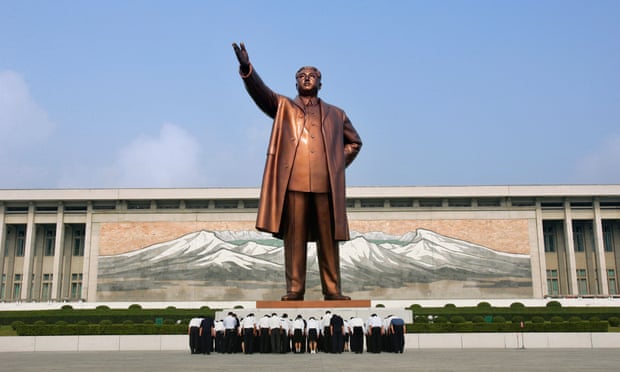 |
| North Koreans pay homage to Kim Il-sung. Image courtesy of The Guardia. |
For North Korea, the historical revisionism
around Kim Il-sung has created an imposter of sorts. The man who lived most of
his life in Manchuria, fought the Japanese alongside Chinese communists, and
retreated to the Soviet Union, was reimagined as a Korean nationalist. With the Century creates a narrative of Kim
Il-sung’s destined rise to free the Korean peninsula and establish a communist utopia.
Kim Il-sung was a cosmopolitan guerilla, engaging in an international conflict
in which Korea was a secondary player. The imposter Kim Il-sung is not found in
the presidential cemetery but instead lives in the North Korean history books. Kim
Il-sung was acutely aware of the significance of his years fighting in
Manchuria, and knew that he must own that significance rather than let his
rivals dictate it. He constructed a propaganda machine that traveled through
history, revising the story of his life.
Kim Il-sung is
technically still the “Eternal President” of North Korea. His son and grandson have
inherited the functions of leadership, but he remains the spiritual source of government
legitimacy. North Korean propaganda antics are ridiculed across the world, but
we should be wary to discount their potency. While claims about Kim Jon-il’s record-breaking
golf game merit some chuckles, the deification of Kim Il-sung represents a much
more insidious form of social control. In my last post, I wrote about the power
of history in dictating collective thought in a nation. The reimagining of Kim
Il-sung’s Manchuria exploits is only the tip of the iceberg in North Korean
propaganda around him, but it is a foundational piece to his cult-of-personality.
Kim Il-sung’s Manchuria lesson was the power of his own historical narrative to
create a national identity that posited him as the hero and role model for his
nation.
Manchuria is a
crucible for 20th century East Asian history. In this Wild West, the
Japanese performed an imperialist project that exploited people and resources
alike. The racism and greed of Nobusuke Kishi inclficted forced labor, drug
trafficking, and systematized sexual assault on the Chinese people. These atrocities
were a necessary piece of his “Manchukuo experiment” that subjugated the military
to private businesses. Park Chung-hee observed this experiment, recognizing the
potential of Kishi’s state-run capitalism but disturbed by the second-tier place
of Japan’s military. After seizing power in South Korea, Park Chung-hee inverted
the combination that Kishi devised and the military dominated business
interests. Both Kishi and Park Chung-hee tinkered with their respective
military-industrial complexes and Kim Il-sung responded not by out-producing
these societies materially. Drawing from his experiences as a guerilla in
Manchuria, Kim Il-sung instead created symbolic victories and fictionalized his
life story. He assimilated the history of North Korea into the history of his
own life. The philosophies for each of these three leaders would become state policy, embroiling East Asia into their personal conflict.
Thank you all for taking the time to read this post! It has been a busy month for me here at Yonsei University, and I am sorry it took so long to produce. The story of these three men is not over yet, and I look forward to sharing more with you about them and their descendants. With just a couple months left in Seoul, I am trying to soak up as many experiences as I can, and I will try to bring many of those to this blog once I finish this detour into history. In the meantime, I would love to hear any thoughts, opinions, questions, or feedback you have on this post. Thanks!
Thank you all for taking the time to read this post! It has been a busy month for me here at Yonsei University, and I am sorry it took so long to produce. The story of these three men is not over yet, and I look forward to sharing more with you about them and their descendants. With just a couple months left in Seoul, I am trying to soak up as many experiences as I can, and I will try to bring many of those to this blog once I finish this detour into history. In the meantime, I would love to hear any thoughts, opinions, questions, or feedback you have on this post. Thanks!
Sources
http://apjjf.org/-Seungsook-Moon/3140/article.html
- “The Cultural Politics of Remembering Park Chung Hee
Manchuria Under
Japanese Dominion (Summary provided by University of Pennsylvania) http://www.upenn.edu/pennpress/book/toc/14203.html
The Two Koreas: A Contemporary History by Don Oberdorfer
Korea, Old and New: A History by Carter J. Ecker, Ki-baik Lee, Young Ick Lew, Michael Robinson, and Edward W. Wagner
